
The Lassonde Curve is a useful framework for understanding how value can be created, lost, and rediscovered throughout the life cycle of a mining project. It is especially relevant for investors looking at junior explorers, resource developers, and early-stage mining companies.
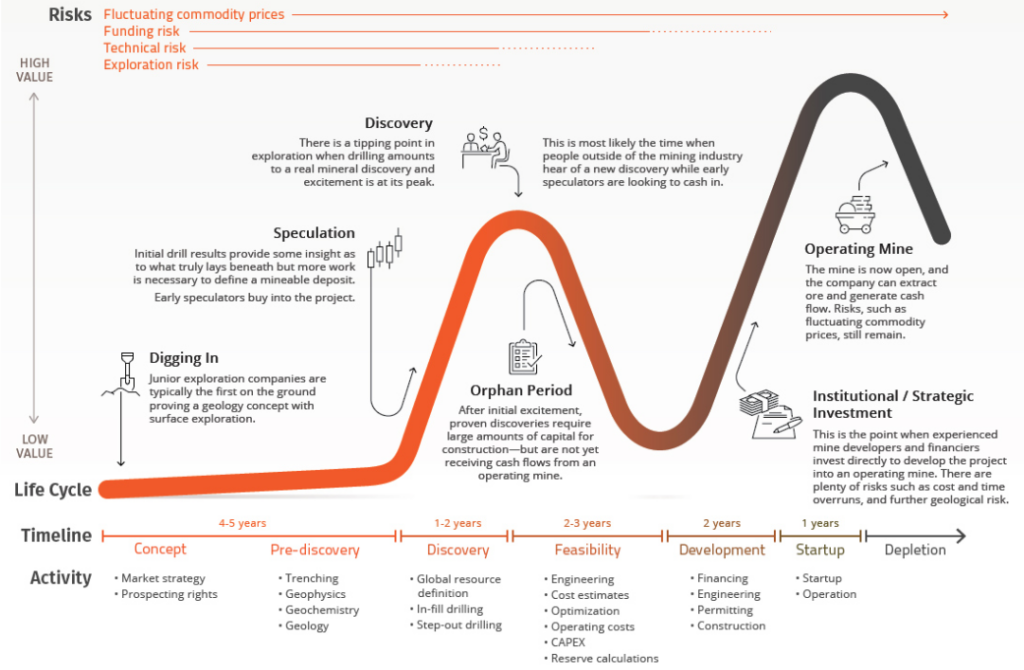
Named after Pierre Lassonde, a prominent figure in the mining industry, the Lassonde Curve illustrates the typical relationship between time, risk, and value during a mining project's development.
In simple terms, the curve shows how mining companies can experience sharp increases in value after discovery, periods of slower interest during feasibility work, and renewed value creation as a project moves towards production.
The key stages of the Lassonde Curve
- Concept / Pre-Discovery: This is the earliest and highest-risk phase. Geologists develop theories about potential mineral deposits based on preliminary data, mapping, sampling, and geological interpretation.
- Discovery: As exploration progresses and promising drilling results emerge, investor interest can increase quickly. This is often where speculative value is created.
- Feasibility Studies: After discovery, the project enters a more detailed analysis phase. This period can see interest fade as investors wait for studies, permits, funding plans, and development decisions.
- Development and Construction: If the project remains viable, the company moves towards financing, construction, and operational preparation. Value may begin to rebuild as the market gains confidence in the project.
- Production: This is when the mine becomes operational and begins generating revenue. At this stage, the project's potential is tested against real-world costs, output, commodity prices, and operational performance.
Why the Lassonde Curve matters for mining investors
Mining investments can move through very different phases. A junior explorer is not valued the same way as a producer, and a discovery-stage company carries very different risks compared with a company already generating cash flow.
For investors, the Lassonde Curve offers several useful insights:
- It helps investors understand potential entry and exit points across the mining project life cycle.
- It highlights why share prices can rise sharply after discovery, then drift during quieter study and funding periods.
- It shows the importance of key milestones such as drilling results, resource estimates, feasibility studies, permits, funding, and production updates.
- It demonstrates the high-risk, high-reward nature of early-stage mining and exploration companies.
Understanding the Lassonde Curve can help investors set more realistic expectations, manage risk, and identify where a company may sit in the broader mining investment cycle.
However, the curve is only a general framework. Individual projects can deviate from the pattern due to market conditions, commodity prices, funding availability, permitting delays, operational issues, or project-specific challenges.
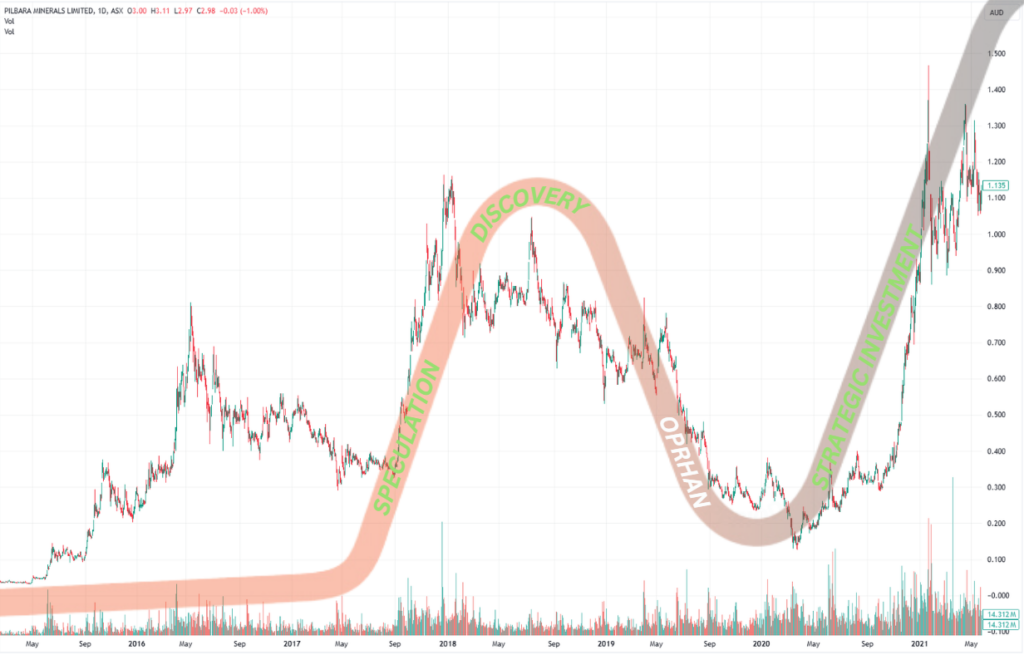
Example: Pilbara Minerals (ASX: PLS)
Pilbara Minerals is a useful example of how a mining company can move through different stages of investor interest, from early exploration and development through to production and market recognition.
Common mining investment terms
- Exploration: The process of searching for mineral deposits through surveys, sampling, mapping, and drilling.
- Discovery: The point at which a significant mineral deposit is found, often leading to increased investor interest.
- Resource Estimation: The process of estimating the size, grade, and quality of a mineral deposit.
- Preliminary Economic Assessment: An early-stage study that provides an initial view of a project's potential economics.
- Feasibility Study: A detailed technical and economic study assessing whether a project is commercially viable.
- Development: The stage where a company prepares for mine construction, including financing, permitting, and operational planning.
- Production: The phase where the mine is operating and generating revenue from mineral extraction.
- Depletion: The gradual reduction of the mineral resource as mining progresses.
- Orphan Period: A quieter period during feasibility or development when investor interest may fade due to limited news flow.
- Drill Core: A cylindrical rock sample collected through drilling and used to assess mineral content and geology.