
Portfolio Strategy: “Risk off”
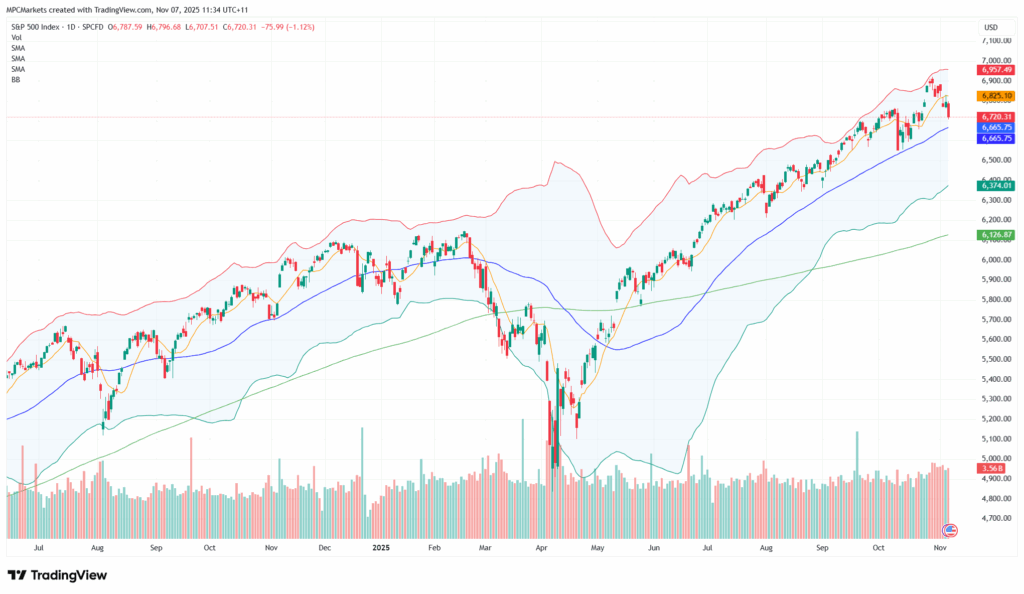
In light of escalating risks across valuations, political uncertainties, credit conditions, and labor market signals, we recommend adopting a defensive “risk-off” posture for client portfolios. This involves raising cash levels, trimming overextended positions, and outright selling select high-risk holdings exposed to volatility. The rationale draws directly from current market data, including record-high overvaluation metrics, persistent trade frictions, an extended government shutdown, widening credit spreads, and a surge in corporate layoffs—the largest since the COVID-19 era. While no single factor guarantees a downturn, their confluence underscores the prudence of de-risking to preserve capital and position for opportunistic re-entry.
We are recommending a trim or sell in a broad range of holdings and increase cash levels
Specifically, the recommendation is to:
- Increase cash allocations where risk tolerance dictates.
- Trim or sell the following holdings
- Trim
- third of BHP
- Sell
- Trim
- Asia ETF – Asian Tech
- DTEC ETF – Defence Technology ETF
- Fortescue FMG
- Goodman Group GMG
- Pilbara Minerals PLS
- Whitehaven Coal WHC
- FANG ETF
This proactive approach proved valuable during previous bouts of market volatility and, even if no correction materialises, leaves investors better organised for future opportunities.
Key Risk Catalysts
- Stretched Valuations Amid Complacency
The U.S. equity market remains profoundly overvalued, with the Buffett Indicator (market capitalization to GDP) at an alarming 220%—a level unseen in modern history. Traditional metrics for the S&P 500, including price-to-earnings, price-to-book, and price-to-sales ratios, are all flashing “overbought” signals as of August 2025 data, implying prices detached from fundamentals like earnings growth or economic output.
Compounding this is the unusual absence of seasonal weakness in September and October, a pattern that historically provides healthy pullbacks. This complacency leaves markets susceptible to sharp corrections, as evidenced by the rally’s unprecedented pace—rarer even than post-GFC or post-COVID rebounds, yet without comparable supportive fundamentals.
Historical context is stark: The S&P 500’s 3-year cumulative return as of 2025 stands at 68.83%, ranking among the highest this century. Below is a summary table of annual total returns and trailing 3-year gains, highlighting the current cycle’s extremity:
- Political and Geopolitical Headwinds
U.S.-China trade tensions have intensified into an overt trade war, with President Trump’s recent declarations amplifying uncertainty. Despite moderating voices within the administration, the lack of a structured diplomatic path elevates shock risks.
Domestically, the federal government shutdown—now in its 16th day, twice the average of prior episodes—delays vital economic releases (e.g., jobs reports, GDP revisions). This opacity hampers informed decision-making and erodes confidence.
- Credit Market Stress
Credit spreads between investment-grade and high-yield corporate bonds have widened abruptly, a classic harbinger of financial strain seen before the Global Financial Crisis (GFC). Though much risky debt resides off-balance-sheet for banks, rising defaults in large-scale deals could cascade into equity sell-offs.
- Labor Weakness
Labor signals are equally concerning: U.S. corporate layoff announcements topped 172,000 in October 2025 alone, pushing the 3-month total beyond 300,000 across S&P 500 firms and private entities—the steepest wave since 2020. Q3 2025 saw 202,118 cuts, driven by tech, retail, finance, manufacturing, and logistics amid economic slowdowns and AI-driven restructuring. Year-to-date, announcements pace toward 1 million, underscoring structural workforce shifts and weakening employment fundamentals.
Disclaimer: The recommendation given is general advice only. It does not take into account your personal objectives, financial situation, or specific needs. This information should not be your sole resource when making such decisions. We strongly recommend you to seek the advice of financial, taxation, and legal professionals before finalising any investment decisions.