

MPC Markets Morning Call — 15 July 2026: Soft CPI Gives the Fed Cover, but Oil and Iran Won’t Let Markets Relax
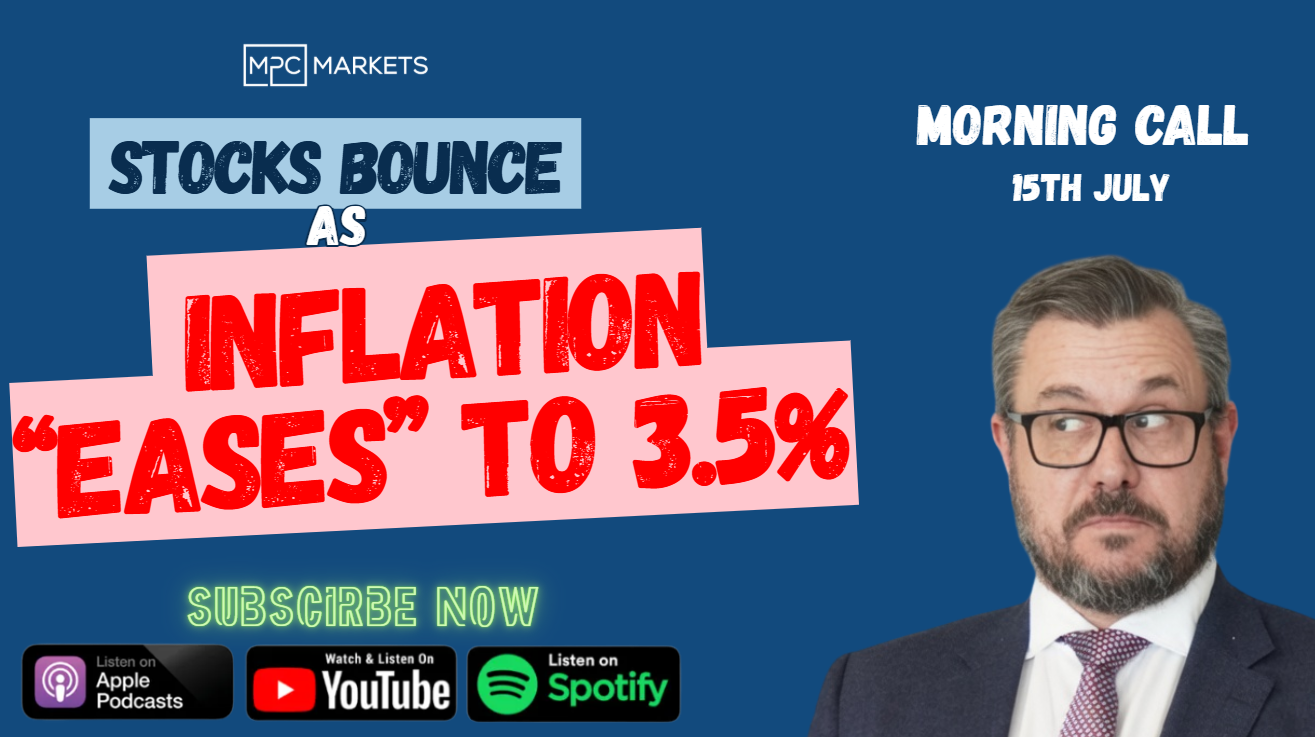
June CPI came in cold — headline prices fell 0.4% month-on-month, the steepest drop since April 2020, dragging annual inflation to 3.5% against a 3.8% consensus. Core CPI was flat. That killed near-term rate hike odds and sent stocks higher, with the S&P 500 closing at 7,544 (+0.38%) and the Nasdaq 100 gaining 1.1%. But here’s the catch: June’s number is already stale. The ceasefire that cratered gasoline prices last month has collapsed, U.S. CENTCOM is running nightly strikes on Iran, and Brent is back above $85. Goldman Sachs smashed every equities trading record ever set by any bank — $7.42 billion in a single quarter — while IBM cratered 25% on a revenue miss blamed on clients rerouting capex into AI hardware. ASX 200 futures point to an opening gain of 49 points (+0.6%) to 8,817.
S&P 500 added 0.38% to 7,544, Nasdaq 100 rose 1.1%, and the Dow was flat at 52,509 as cooler CPI and big-bank earnings lifted risk appetite.
June headline CPI fell 0.4% M/M (biggest drop in six years) on collapsing gasoline prices, but renewed U.S.–Iran strikes mean July’s reading won’t be nearly as friendly.
Brent crude settled at $85.21 (+2.3%) and WTI at $79.79 (+2.1%) as CENTCOM resumed Iran’s naval blockade and launched another wave of strikes.
Ten-year Treasury yields fell 4bp to 4.58%, the dollar dropped 0.4%, and gold rallied 1.3% to $4,055 as markets priced an 83.4% chance the Fed holds in July.
Goldman Sachs surged 9.1% on a record $7.42 billion equities quarter, JPMorgan posted its highest-ever profit, and IBM plunged 25% on a revenue miss.
ASX 200 futures are up 49 points (+0.6%) to 8,817; DeepSeek is preparing an IPO filing at a $71 billion valuation, and China’s June exports surged past forecasts.

Equities: Banks Crushed It, IBM Got Crushed
The S&P 500 ground out a 0.38% gain to close at 7,544. Nasdaq 100 did better at +1.1%, helped by a chip rebound after days of selling. The Dow? Barely moved. It added 10 points — you could round that to zero and nobody would argue. The real story was under the hood: Goldman Sachs posted $7.42 billion in equities trading revenue (up 72% year-on-year, a record for any bank, anywhere, ever), and the stock ripped 9.1% to a 52-week high of $1,136. JPMorgan hauled in $6 billion from stocks alone and reported $58 billion in total revenue with EPS of $6.14. Jamie Dimon called it “as close to as good as it gets,” then added the kicker: “We just don’t know how long it’s going to last.”
Bank of America beat on both lines ($1.21 EPS vs $1.12 expected) and Wells Fargo delivered $2.00 EPS against a $1.72 estimate, though Wells stock still fell 2.7% because investors fixated on flat NIM guidance. Citi was the oddity: a 45% jump in net income, record decade-high revenue of $24.8 billion, yet the stock dropped 5.3% because Jane Fraser kept the full-year return target at 10–11% instead of raising it. Markets wanted a reward. Citi gave them a “we’ll see.”
Then there was IBM. Down 25%. Its worst day since 1968. Preliminary Q2 revenue came in at $17.2 billion vs the $17.9 billion estimate, and management blamed clients who yanked their quarterly capex away from software and mainframes to pile cash into AI servers and memory. The irony is rich: the AI boom is crushing legacy tech by stealing its budget.

“The build-out of AI infrastructure remains in its early stages, and we believe this multi-year investment cycle will continue to drive elevated levels of strategic activity, financing, and capital formation across markets.” Solomon said the industry “is in the middle of an AI capex super cycle” with demand for every single financing instrument. Goldman was lead underwriter on the SpaceX IPO and is positioned to co-lead the upcoming Anthropic listing.
Iran, Hormuz, and the CPI That’s Already Obsolete
The June CPI was terrific. Headline down 0.4% month-on-month. Core flat. Annual inflation at 3.5%, well below the 3.8% consensus. Gasoline prices cratered 9.7% in the month, the biggest single-month drop since August 2022. All of that happened because the U.S. and Iran signed an interim memorandum of understanding in mid-June that reopened the Strait of Hormuz and sent Brent tumbling more than 20%.
That deal is now dead. The ceasefire collapsed after reported Iranian attacks on commercial oil tankers in and around the Strait. CENTCOM has launched four consecutive nights of strikes. Trump reimposed the naval blockade on Iranian ports, and more than 20 U.S. Navy warships and hundreds of military aircraft are operating across the Middle East. Hormuz traffic has slowed to a two-month low.

Trump scrapped the 20% Hormuz reimbursement fee he floated on Monday, replacing it with Gulf state investment deals. “I was called by different people, different countries, kings and emirs,” Trump said at a bilateral meeting with the Iraqi PM. “They said we’d love to invest in the United States with billions and billions of dollars.” Oil pared gains after the announcement, but Brent still settled above $85.
Fed Chair Kevin Warsh took the podium for his first congressional testimony and poured cold water on anyone tempted to declare victory. “There might be some that look at this morning’s data and say, ‘Oh, mission accomplished. Everything is swell,’” Warsh told the House Financial Services Committee. “That is not my view.” He reiterated the FOMC has “no tolerance for persistently elevated inflation” and took another swipe at forward guidance, saying the Fed will stop telegraphing rate decisions in advance.

“The members of our committee have no tolerance for persistently elevated inflation. And we share a resolute commitment to restoring price stability.” Warsh added: “Inflation is a choice. Monetary policymakers need to choose lower prices.” He pushed back against forward guidance, saying being “more circumspect in our communications” is “a better way of calling balls and strikes.” Markets still have at least one 25bp hike priced by year-end.
“Softer than expected CPI is a big relief. While today’s report will not eliminate discussion of further tightening entirely, it should effectively remove a July rate hike from consideration.” Wilding said the latest CPI is an important step toward validating bets that inflation will cool in the second half, supporting her view the Fed remains on hold through 2026.
Energy, Commodities & FX
Brent settled at $85.21, up 2.3% on the session and roughly 30% above its mid-June lows. WTI climbed 2.1% to $79.79. Both had traded higher intraday (Brent touched $87.55, up 5.1%) before Trump’s scrapping of the Hormuz fee took some froth off. The bigger picture: global strategic petroleum reserves have fallen to critically low levels, dated Brent is trading at its widest premium to futures in a month, and crack spreads have hit record highs. Adam Turnquist at LPL Financial flagged $86 as near-term resistance for Brent, with a close above that opening the door to $92 at the 50-day moving average.
Gold added 1.3% to $4,055.36 an ounce, catching a bid from the softer dollar and risk hedging. The Bloomberg Dollar Spot Index fell 0.4%. Euro gained 0.3% to $1.1419, sterling rose 0.3% to $1.3387, and the yen firmed 0.1% to ¥162.22. Bitcoin surged 3.8% to $64,485 and Ether jumped 6.2% to $1,876 — risk-on with a crypto twist.
The 10-year Treasury yield fell 4 basis points to 4.58% as the CPI print pulled rate hike expectations lower. Short-dated Treasuries outperformed as money markets unwound bets on a July move. Germany’s 10-year held steady at 3.11% and Britain’s at 4.98%.

“Global strategic petroleum reserves have fallen to critically low levels. Dated Brent is trading at its widest premium to futures in a month. Meanwhile, crack spreads have risen to record highs. Together, these indicators point to a tightening oil market and greater sensitivity to geopolitical headlines.” Turnquist sees $86 as near-term resistance, with $92 the next level if that clears.
AI Capital Cycle and the DeepSeek IPO
DeepSeek is preparing to file for an IPO as early as this year, targeting a mainland listing in 2027. The Hangzhou-based AI lab is talking to new backers about a fresh round at a pre-money valuation of at least 480 billion yuan ($71 billion), up from the roughly $50 billion tag on its record $7 billion first-round financing in June (Tencent, CATL). Founder Liang Wenfeng is now worth $36 billion, making him the world’s richest AI model creator — ahead of Anthropic’s Dario Amodei and OpenAI’s Greg Brockman.
Speaking of OpenAI: the company’s first hardware device will be a movable, screenless smart speaker designed as an AI companion, built with former Apple design legend Jony Ive’s studio. It includes a camera, sensors, rechargeable battery, and a more advanced version of GPT-Live voice mode. Apple sued OpenAI last week for trade secret theft. OpenAI says it’s “not aware of any evidence that this complaint has merit.” Sonos shares fell more than 10% on the news.
SpaceX, meanwhile, has slumped back to almost its $135 IPO price, with shares at $136.08 after falling 3.1% on Monday. It’s erased over 40% from its $225.64 peak hit less than two weeks after listing. In other AI infrastructure news, cloud provider Nebius agreed to sell more than $1 billion of computing power (Nvidia GB300 chips) to Reflection AI through 2029. And TSMC’s June sales update beat forecasts again, while China’s exports surged past estimates — chips, tech equipment, and a record one million car exports in a single month.

ASX Outlook & Day Ahead
ASX 200 futures are up 49 points (+0.6%) to 8,817, and the local market should open with a firm bid. The big banks’ blowout quarter is a direct read-through for CBA, NAB, and Macquarie, particularly the trading and IB revenue lines. Oil above $85 keeps energy names in play, though the continued Iran instability adds a risk premium that cuts both ways for the broader index. Gold at $4,055 supports the local gold miners.
The ASX opens into a session shaped by the overnight CPI relief, record Wall Street bank earnings, and the renewed U.S.–Iran escalation. The AUD benefits from the weaker dollar, and energy stocks will track Brent closely.
- ASX 200 Open (10:00 AEST) — Futures indicate a 49-point (+0.6%) gain to 8,817. Watch bank and energy sectors for early momentum.
- China Activity Data (12:00 AEST) — Q2 GDP, industrial production, and retail sales due. June exports already beat, so strength here would be ASX-positive via resources.
- U.S.–Iran Blockade (Ongoing) — Naval blockade reimposed at 06:00 AEST. Any escalation beyond current strikes will spike oil and pressure equity sentiment.
- U.S. Bank Earnings Fallout — Goldman +9.1%, JPM +2.5%. Read-throughs for Macquarie and ASX-listed fund managers on trading volumes and deal pipelines.
- Fed Warsh Congressional Testimony (Day 2) — Warsh appears before the Senate Banking Committee. Any shift in tone on rate hikes will move bonds and the AUD.
June CPI inflation 2026, US Iran naval blockade Hormuz, Goldman Sachs record earnings, IBM revenue miss AI capex, DeepSeek IPO valuation, ASX 200 outlook July 2026