Macquarie group MQG:ASX
Date: 11/02/2025
*** GENERAL ADVICE ONLY***
- Overview
Macquarie Group Limited has released its earnings report for Q3 2025, showcasing a blend of robust growth in key areas alongside challenges in certain commodity markets. The company continues to focus on active management of its asset and liability portfolios to bolster its balance sheet’s structural integrity, thereby enhancing liquidity and funding positions as of December 31, 2024. Strategic initiatives, including significant capital allocations and a proactive share buyback program, underscore Macquarie’s commitment to sustaining its market position amidst evolving regulatory landscapes and economic conditions.
- Financial Performance
Revenue & Growth Trends
- FY 2024 achieved a significant revenue milestone of A$3.8 billion, marking a substantial increase from FY 2023.
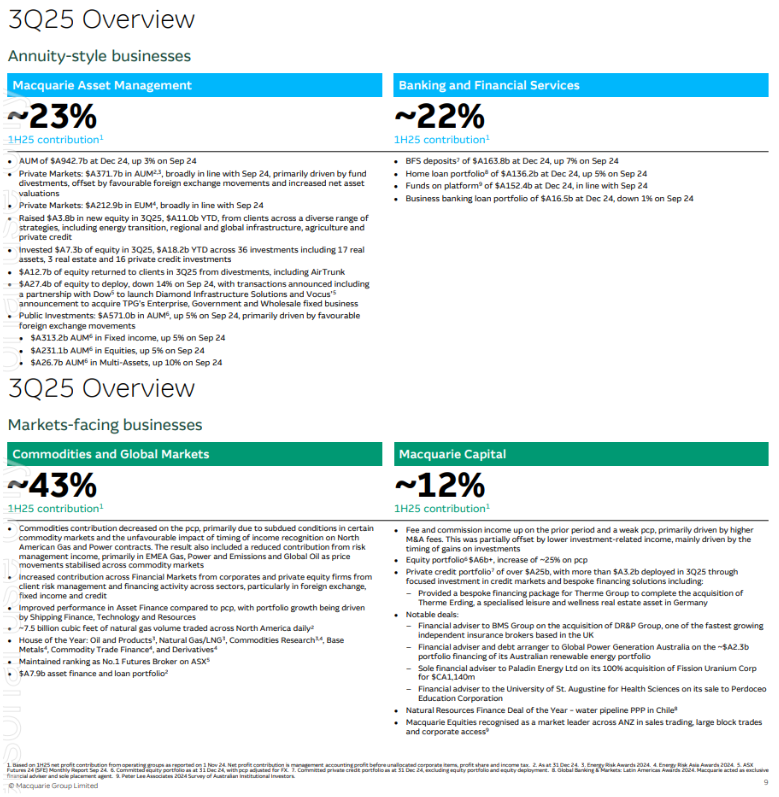
- BFS deposits grew by 7% year-over-year, reflecting strong customer trust and market demand.
- Home loan portfolios increased by 5%, indicating a steady growth in the housing market segment.
- Assets Under Management saw a positive trajectory across multiple categories, with a notable 10% increase in Multi-Assets AUM.
Margin & Profitability Metrics
- Despite revenue growth, subdued conditions in certain commodity markets adversely impacted net profit in Q3 2025.
- The Group Capital Surplus decreased by A$1.3 billion, reflecting increased business capital requirements and dividend distributions.
Notable Year-over-Year (YoY) and Quarter-over-Quarter (QoQ) Changes
- Equity to deploy decreased by 14% compared to September 2024, indicating a strategic reallocation of resources.
- Business banking loan portfolio saw a marginal decline of 1%, suggesting a cautious approach in lending practices.
- Guidance and Expectations
- Macquarie has extended its on-market share buyback program, acquiring A$1,013 million worth of shares at an average price of A$189.80 per share as of February 10, 2025. This move provides the company with additional flexibility to manage its capital position effectively, allowing for variations, pauses, or termination of the buyback as necessary.
- The reduction in Group Capital Surplus was primarily driven by increased business capital requirements and the distribution of dividends in the first half of 2025, which was partially offset by the profitability from the third quarter’s P&L performance.
- Competitive Landscape
- In the financial services sector, Macquarie maintains a strong market position through diversified asset management and robust deposit growth.
- Comparatively, Macquarie’s AUM growth outpaces several peers, particularly in the Multi-Assets category, positioning it favorably against competitors.
- However, challenges in the commodity markets pose potential threats, as seen by the negative impact on net profits, which could affect Macquarie’s competitiveness if trends persist.
- Strategic Considerations
Operational and Cost Initiatives
- Macquarie continues to emphasize the active management of both asset and liability portfolios to uphold the structural integrity of its balance sheet.
- Implementation of a remediation plan with APRA aims to enhance governance, culture, and risk management, ensuring compliance and strengthening operational resilience.
Capital Allocation Plans
- Significant capital has been allocated towards strategic growth initiatives, reflected in the increased AUM across various categories.
- The ongoing share buyback program demonstrates a commitment to returning value to shareholders while maintaining flexibility to adapt to market conditions.
- Dividend distributions in 1H25 highlight Macquarie’s balanced approach to rewarding investors while managing capital requirements.
Expected Impact on Near & Long-Term Outlook
- Strategic growth initiatives and active portfolio management are expected to sustain revenue growth and enhance market positioning in the near term.
- Regulatory compliance and remediation efforts will likely bolster long-term operational stability and investor confidence.
- Continued focus on liquidity and funding positions will ensure Macquarie remains resilient amidst economic fluctuations and market uncertainties.
- Regulatory Environment
Capital Requirements
- Total regulatory capital requirement stands at A$29.1 billion at 10.5%, with a Group surplus of A$9.8 billion.
- As of September 30, 2024, the total APRA Basel III capital supply is A$38.9 billion, positioning Macquarie well within regulatory capital norms.
- Key ratios include:
- APRA Basel III Level 2 CET1 Ratio: 12.6% vs. Harmonised Basel III Level 2 CET1 Ratio: 17.7%
- APRA Basel III Leverage Ratio: 5.0% vs. Harmonised Basel III Leverage Ratio: 5.7%
- Liquidity Coverage Ratio (Q3 2024): 196%
- Net Stable Funding Ratio (Q3 2024): 113%
Comparison to Broker Consensus
The trading update seems to be slightly below broker expectations:
- Morgan Stanley had forecast a 10% higher net profit contribution for Q3, supported by stronger equity and debt markets and a weaker Australian dollar.
- Citi had noted that 2025 might present an improved outlook for deal-making and a weaker AUD, with more positive commentary on gas prices contributing to a more optimistic outlook.
- UBS had recently increased its target price for Macquarie Group to $235, indicating expectations of growth.
- The consensus of analyst estimates projected 40% profit growth in 2025, hitting $9.80 earnings per share (EPS).
While Macquarie’s performance was broadly in line with the previous year, it appears to have fallen short of the more optimistic growth projections from some brokers. The challenges faced by the markets-facing businesses, particularly in commodity markets, likely contributed to this underperformance relative to expectations.
It’s worth noting that Macquarie’s financial position remains strong, with the group capital surplus at $A8.5 billion1, which may provide some reassurance to investors despite the earnings update being slightly below consensus expectations.
Disclaimer: The recommendation given is general advice only. It does not take into account your personal objectives, financial situation, or specific needs. This information should not be your sole resource when making such decisions. We strongly recommend you to seek the advice of financial, taxation, and legal professionals before finalising any investment decisions.