Investment Thesis
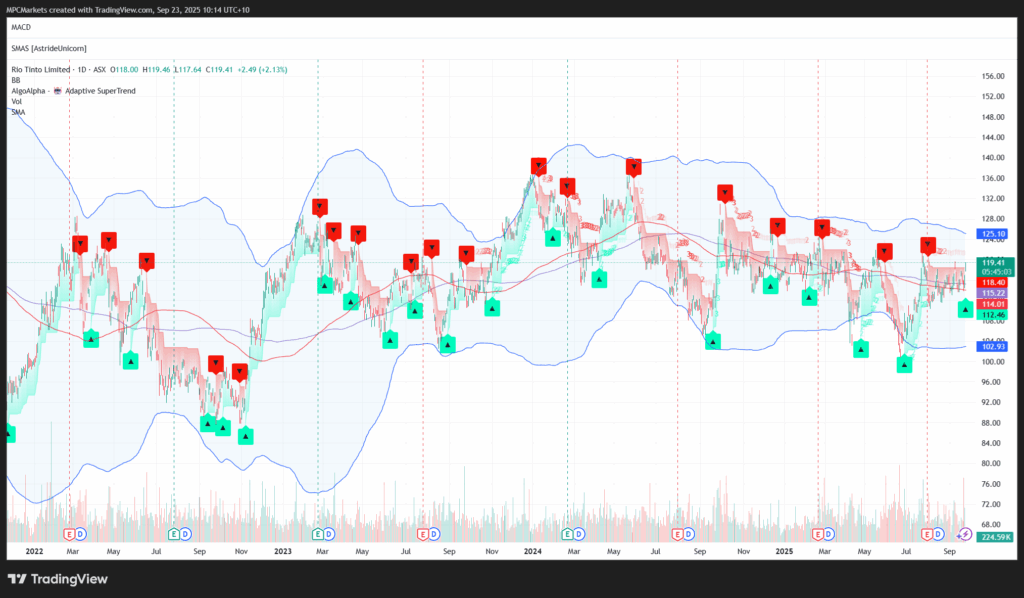
We recommend switching from Fortescue to Rio Tinto at an entry price of 119.5 dollars, with a target of 140 dollars and stop loss at 105 dollars. Our core investment case centres on RIO’s diversified portfolio, which extends beyond iron ore to include significant copper and aluminium exposure. This positions RIO to capitalise on surging demand from data centres, electrification, and the energy transition, while its higher-grade iron ore assets provide a stable base amid volatile commodity prices. We believe this mix enhances long-term value creation compared to Fortescue’s heavy reliance on lower-grade iron ore.
RIO’s competitive advantages are evident in its market standing as a global leader. Its Pilbara operations deliver 61.5 per cent Fe iron ore, favoured for efficiency and lower emissions versus Fortescue’s 58 per cent average. With revenue diversified—60 per cent iron ore, 20 per cent aluminium, and 12 per cent copper—RIO exhibits strong geographic and commodity spread, buffering against sector downturns. Production growth in copper, targeting up to 850000 tonnes in 2025, and aluminium output near 3.3 million tonnes underscore its scale.
At current levels, RIO offers compelling value with a robust balance sheet and cost discipline, contrasting Fortescue’s higher debt and speculative green hydrogen ventures. Our analysis indicates favourable upside from macro and geopolitical tailwinds in critical minerals.
Catalysts and Growth Drivers
Our analysis of the iron ore and diversified mining sector reveals a market environment shaped by softening steel demand amid China’s economic slowdown, with iron ore prices hovering around 100 dollars per tonne. However, emerging trends in data centres, electrification, and the energy transition are boosting demand for copper and aluminium, projected to grow by 5-7 per cent annually through 2030. In this landscape, Rio Tinto’s diversified portfolio positions it advantageously against pure-play iron ore producers like Fortescue, as geopolitical tensions in supply chains favour established, multi-commodity players with global footprints.
- Rio Tinto produces higher grade iron ore (61.5% Fe) vs Fortescue (58% Fe, improving).
- Rio Tinto expects 780,000–850,000 tonnes of copper in 2025; Fortescue produces none.
- Rio Tinto produces ~3.3 million tonnes of aluminium per year; Fortescue produces none.
- Revenue mix: Rio Tinto earns 60% from iron ore, 20% aluminium, 12% copper; Fortescue earns 95% from iron ore.
Financially, Rio Tinto demonstrates robust performance with underlying earnings of 12 billion dollars in 2024, supported by a diversified revenue mix where iron ore contributes 60 per cent, aluminium 20 per cent, and copper 12 per cent. This contrasts with Fortescue’s 95 per cent iron ore reliance, which exposed it to price volatility, resulting in narrower margins of around 40 per cent versus Rio’s 50 per cent operating margin. Rio’s balance sheet remains strong, with net debt below 5 billion dollars and free cash flow generation exceeding 10 billion dollars annually, enabling shareholder returns through dividends yielding 6 per cent and buybacks.
Rio Tinto’s competitive position is fortified by its high-grade Pilbara iron ore assets averaging 61.5 per cent Fe, superior to Fortescue’s 58 per cent, allowing premium pricing and lower emissions appeal to steelmakers. As the world’s second-largest miner, Rio holds significant market share in copper via Oyu Tolgoi and in aluminium through integrated smelters, providing operational leverage absent in Fortescue’s iron ore-centric model and reducing vulnerability to single-commodity downturns.
Key growth drivers for Rio include copper production targeting 850,000 tonnes in 2025, up 15 per cent year-on-year, driven by expansions at Resolution and Escondida mines, which we expect to add 2-3 billion dollars in EBITDA by 2027. Aluminium output near 3.3 million tonnes supports data centre infrastructure demand, while geographic diversity across Australia, Mongolia, and Canada enhances resilience. We believe these catalysts underpin earnings growth of 8-10 per cent annually, justifying our target price of 140 dollars from an entry of 119.5 dollars.
Risks include commodity price fluctuations and Chinese demand weakness, potentially pressuring iron ore revenues, alongside execution delays in copper projects. However, Rio mitigates these through cost discipline, with unit costs 10 per cent below peers, and a conservative balance sheet that supports a stop loss at 105 dollars. Overall, the risk-reward profile favours Rio, offering superior diversification and upside from green economy trends over Fortescue’s speculative green hydrogen pivot.
Disclaimer: The recommendation given is general advice only. It does not take into account your personal objectives, financial situation, or specific needs. This information should not be your sole resource when making such decisions. We strongly recommend you to seek the advice of financial, taxation, and legal professionals before finalising any investment decisions.