ETF Investing for Beginners: The Simple Way to Get Started on the ASX
Last reviewed: May 2026
We reckon ETFs are the single best starting point for most Australian investors. Full stop. They let you own hundreds or thousands of companies, spread across continents and sectors, for less than you'd spend on a streaming subscription each year. And you don't need to predict the future or spend weekends reading annual reports to use them.
An ETF costs you somewhere between 0.05% and 0.30% per year, rebalances itself, trades on the ASX like any other share, and doesn't punish you for not being a stock-picking genius. If you've got a brokerage account and a few thousand dollars, you can genuinely start today. This guide covers the how.
What is an ETF? (And why it's simpler than it sounds)
An exchange-traded fund is a basket of investments packaged together and traded as a single unit on the stock exchange. Think of it as buying one share that automatically gives you ownership of 300 companies.
VAS (Vanguard Australian Shares ETF) is a good example. It holds all 300 companies in the ASX 300 index. One purchase of VAS and you instantly own a piece of Commonwealth Bank, BHP, Woolworths, CSL, and 296 others. If one of those companies has a shocker of a quarter, it barely moves your overall position. But if the broader Australian market rises, you rise with it.
That's really it. You're not trying to pick winners. You're owning the whole market and letting the maths do the heavy lifting.
Why are ETFs the best starting point for beginners?
Three reasons, and they're all pretty compelling.
Instant diversification. One purchase gives you hundreds or thousands of holdings. You literally cannot accidentally put all your eggs in one basket. Low cost. Management fees (called MERs) sit between 0.08% and 0.40% per year, compared with 1.0% to 2.0% for traditional managed funds. That difference compounds into tens of thousands of dollars over a lifetime, and yes, that's eye-watering when you see the numbers. Simplicity. No picking winners, no stock tips from your mate at the barbecue, no sleepless nights. You buy, you hold, and time does the work.
And frankly, most professional fund managers don't beat the market over long periods either. So why would you try to pick individual stocks when you can own the whole market cheaply?
How do you buy ETFs on the ASX?
The process is straightforward. Here are the steps.
Step 1: Open a brokerage account
You need an account with an ASX-licensed broker. The popular beginner-friendly options include CommSec (around $10 per trade, part of Commonwealth Bank), Selfwealth (flat $9.50 per trade, clean interface), Stake (low-cost, mobile-first), and Raiz (micro-investing through round-ups, great for building the habit but not ideal for lump sums).
Pick one. Opening an account takes about 10 minutes online. Link your bank account and you're ready to trade.
Step 2: Research your ETFs (but keep it simple)
For a beginner, narrow your search to three building blocks:
| Asset Class | ETF | MER | What It Holds |
|---|---|---|---|
| Australian shares | VAS or A200 | 0.07%–0.10% | Top 200–300 ASX companies |
| International shares | VGS or VGAD | 0.18%–0.21% | Around 2,000 developed-market companies |
| Bonds | VBND or VAF | 0.20% | Government and corporate bonds |
Don't go researching 50 ETFs. These three categories are tried, tested, low-cost, and liquid. Start here. You can branch out later, but honestly this is the 80/20 solution for most people.
Step 3: Place your first trade
Log into your brokerage account, search for the ETF ticker (say "VAS"), click buy, enter the quantity, review the order, and confirm. Done. It settles in two business days, and the ETF is yours.
On costs: if you use a $10 flat-fee broker and buy $5,000 worth of VAS, that's $10 in brokerage. The ongoing MER is 0.07% per year. You're in good shape from day one.
Starting out? Let's make sure you're on the right track
Book a complimentary MPC Portfolio Review, 30 minutes, no cost. We'll look at what you've got, what you're missing, and where to go from here.
Book a Portfolio ReviewStep 4: What about CHESS sponsorship?
CHESS (Clearing House Electronic Sub-register System) is how the ASX records who owns what. When you buy through a CHESS-sponsored broker, you get a unique HIN (Holder Identification Number) and your units are registered in your name directly with the ASX. You own them outright, not through the broker. If your broker goes under, your holdings are protected.
Some newer fintech brokers use a custodial model instead, meaning they hold the shares on your behalf. For a beginner that's fine, but many investors prefer direct CHESS registration for peace of mind. CommSec and Selfwealth both offer it. Worth checking before you open an account.
What should you look for when choosing an ETF?
How much does it cost? (The MER)
The Management Expense Ratio is the annual fee charged as a percentage of your holdings. Here's how the numbers stack up:
| Fund Type | Typical MER | Annual Cost on $100k |
|---|---|---|
| VAS (passive) | 0.07% | $70 |
| A200 (passive) | 0.10% | $100 |
| Typical active managed fund | 1.0%–1.5% | $1,000–$1,500 |
A 0.2% difference sounds like nothing. Over 30 years, it compounds into tens of thousands of dollars in wealth you never get back. Always go with the lowest-cost option when everything else is equal.
Can you buy and sell it easily? (Liquidity)
Liquidity is how easy it is to trade without moving the price. VAS, VGS, and VBND are highly liquid, with thousands of units trading daily. Niche ETFs (something like an "Emerging Markets Dividend Growth" fund) can be illiquid, meaning you wait around or accept a wider bid-ask spread. For beginners, stick to the popular ones.
How well does it track the index? (Tracking error)
An ETF's whole job is to mirror an index. Tracking error is the gap between the ETF's return and the index return. For the big cheap index ETFs, this gap is tiny, usually less than 0.1%. Not a major worry for beginners, but if you spot an ETF with 0.5% or more in annual tracking error, that's a red flag.
Which ETFs are best for beginners in Australia?
We get asked this constantly. Here are five solid options that cover the basics.
| ETF | MER | What It Does | Approx. Yield |
|---|---|---|---|
| VAS | 0.07% | 300 largest ASX companies | Around 4% (franked) |
| VGS | 0.18% | Around 2,000 global developed-market companies (unhedged) | Around 2% |
| VGAD | 0.21% | Same as VGS but currency-hedged to AUD | Around 2% |
| VBND | 0.20% | Australian government and corporate bonds | Around 4.2% |
| A200 | 0.10% | Top 200 ASX companies | Around 4% (franked) |
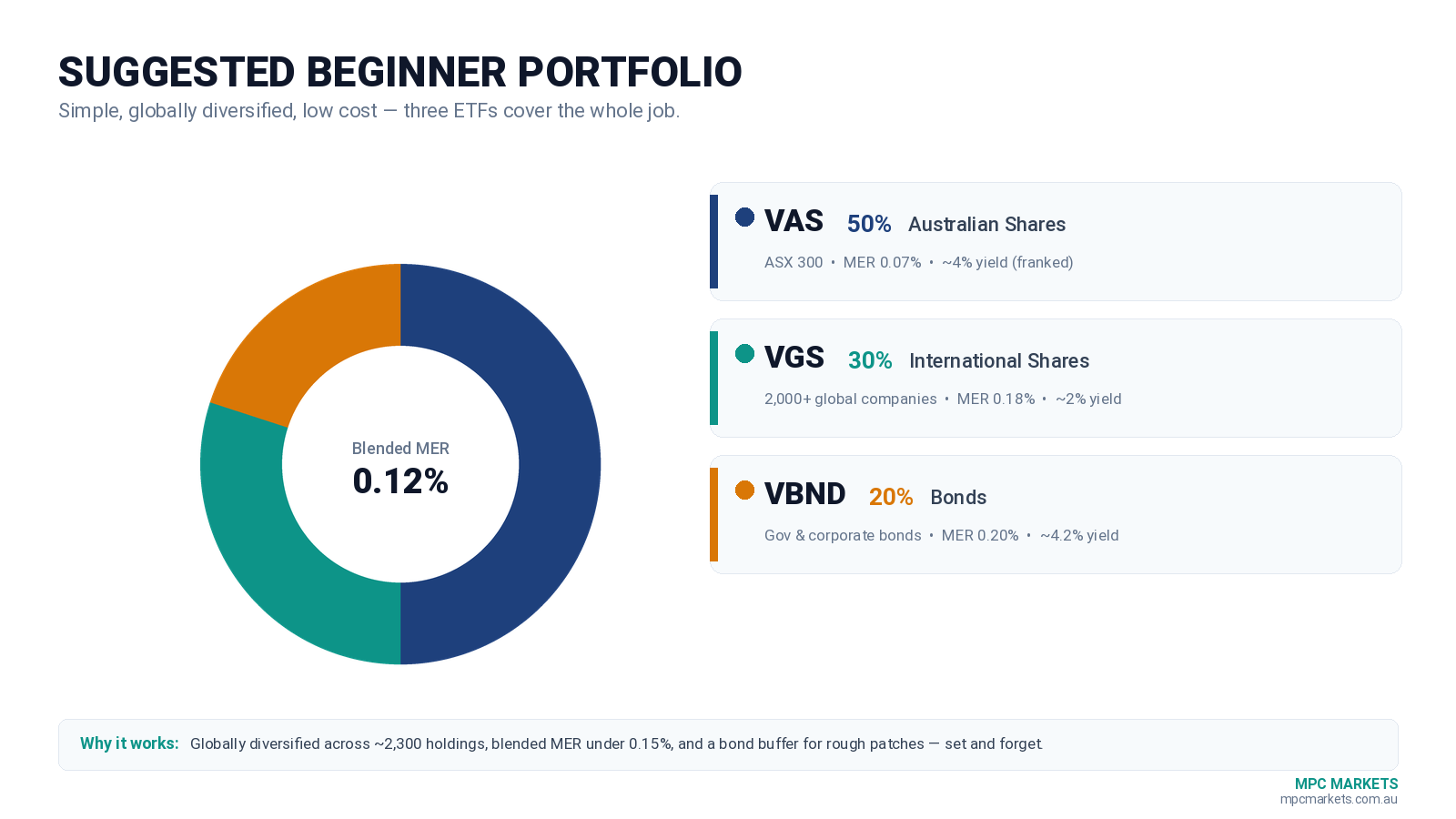
If you're starting from scratch, we'd suggest something like 50% VAS, 30% VGS, and 20% VBND. Globally diversified, dirt cheap, with enough bonds to cushion the rough patches. Job done.
Take the guesswork out of portfolio construction
Our Wealth Engine strategy builds on the same principles covered here, blending growth and income into a structured portfolio. See how the modern 60/40 works.
Explore Wealth EngineWhat are the most common beginner mistakes with ETFs?
Buying too many ETFs
Beginners often think more is safer. They buy 10 different ETFs and end up with accidental overlap, holding the same companies multiple times without realising it. Stick to 3 to 5 core holdings. You really don't need 30.
Waiting for the "perfect" entry price
Everyone wants to buy the dip. The problem is you don't know where the dip is, and waiting means missing out on compounding. If you're investing for a 10-plus year horizon, the entry price barely matters. Dollar-cost averaging, investing the same amount monthly, removes this worry entirely.
Thinking fees don't matter because they look small
A 1% fee difference on a $100,000 portfolio is $1,000 per year. Over 30 years at 6% returns, that's over $80,000 in wealth you never see. Fees matter enormously. Always compare them.
Panic-selling during downturns
Markets fall. That's just what they do. When VAS drops 20%, the instinct is to sell and "wait for it to recover." Then it recovers while you're on the sidelines, and you've locked in a loss for nothing. The fix: only invest money you won't need for five-plus years, and don't check prices daily. Quarterly or even annually is enough. Blissful ignorance leads to better outcomes, funnily enough.
Forgetting about tax outside super
If you're investing outside superannuation, you'll pay tax on dividends and capital gains. Australian shares generate franking credits that offset some of that tax. But international shares (VGS, VGAD) don't generate franking credits. It's not a reason to avoid international ETFs, but it's worth understanding so tax time doesn't catch you off guard.
What should you expect in your first six months?
You've opened a broker account, bought your first ETFs. Congratulations. Now what?
Months 1 to 2: Probably nothing exciting. Markets move around, your portfolio value shifts by a few percent. You might check it daily. Try not to.
Month 3: You'll likely receive a dividend payment from VAS. On a $5,000 holding it might be $50. Reinvest it. Don't spend it on lunch.
Month 6: You're comfortable with the process by now. You might add more money, adjust your allocation slightly, or get tempted by a "hot stock tip" from someone at work. Don't. Stick to your ETF allocation and keep adding regularly. The real power comes from consistency and time, not from being clever.
Learn the fundamentals in a live session
We run regular free webinars covering ETF basics and portfolio building. Come along, ask questions, and get clarity before you commit your capital.
Browse Upcoming WebinarsFrequently Asked Questions
What is an ETF and how does it work?
An ETF (exchange-traded fund) is a basket of securities bundled into one fund that trades on a stock exchange like an ordinary share. Buy one unit and you effectively own a tiny slice of every company in the fund's underlying index. The fund manager replicates that index, your return mirrors its performance minus a small management fee, and you get the diversification of a managed fund with the on-market liquidity of a share.
How do I buy an ETF on the ASX?
Buying an ETF on the ASX is identical to buying a share. Open a brokerage account (CommSec, Selfwealth, Stake, or similar), fund it via bank transfer, search for the ETF by its ASX code (e.g. VAS), and place a buy order. Settlement is two business days after the trade and your units appear in your CHESS-sponsored HIN, giving you direct legal ownership.
What fees should I watch for with ETFs?
The main ongoing fee is the Management Expense Ratio (MER), expressed as an annual percentage of your investment. For passive ETFs, MERs range from 0.03% to 0.25%. You will also pay brokerage when buying and selling, typically $0 to $15 per trade depending on your broker. For a beginner portfolio, keeping the blended MER below 0.20% is a solid target.
What are the best ETFs for beginners in Australia?
Three ETFs form an excellent beginner foundation: VAS (Vanguard Australian Shares, MER 0.07%) for the top 300 ASX companies, VGS (Vanguard MSCI International Shares, MER 0.18%) for broad global exposure, and VAF or VBND for fixed income stability. Together these provide genuine global diversification across thousands of securities at very low cost.
What is CHESS sponsorship and why does it matter?
CHESS is the ASX system that records share and ETF ownership. When you buy through a CHESS-sponsored broker, your units are registered in your name directly with the ASX. If your broker goes bust, your holdings are protected because you own them directly. Some newer fintech brokers use a custodial model instead, so check before opening an account.