How to Build a Diversified ETF Portfolio in Australia: Step-by-Step Guide
Last reviewed: May 2026
Building a diversified portfolio used to require serious money, a financial adviser on speed dial, and a stomach for complexity. Not anymore. An Australian investor with a few thousand dollars and a brokerage account can now own a slice of global markets, Australian dividend stocks, international property, and emerging market growth through a handful of ETFs on the ASX.
And we reckon that's one of the best wealth-building developments of the past two decades.
But here's where most people go wrong. They either end up with 30 different ETF holdings that overlap each other constantly, or they chuck everything into one "growth" ETF and call it diversified. The sweet spot is a core-satellite approach: a solid foundation of broad index ETFs, with some tactical flexibility around the edges. Let's walk through how to build one.
Why are ETFs the foundation of portfolio diversification?
ETFs pool investor money to hold baskets of assets, whether shares, bonds, property, or commodities, and trade on stock exchanges like the ASX with the simplicity of buying a single stock. One purchase gives you exposure to hundreds or even thousands of underlying holdings. That's instant diversification.
The cost advantage is real too. Management Expense Ratios (MERs) typically run 0.05% to 0.40% for index-tracking ETFs, compared to 1.0% to 2.0% for active managed funds. That difference compounds enormously over time.
We've run the numbers on this. An investor starting with $50,000 and contributing $500 monthly will have an extra $150,000 or more in real wealth over 30 years simply by choosing a 0.20% MER product over a 1.5% MER product. That's not a rounding error. That's a house deposit.
What is the core-satellite approach to ETF portfolio construction?
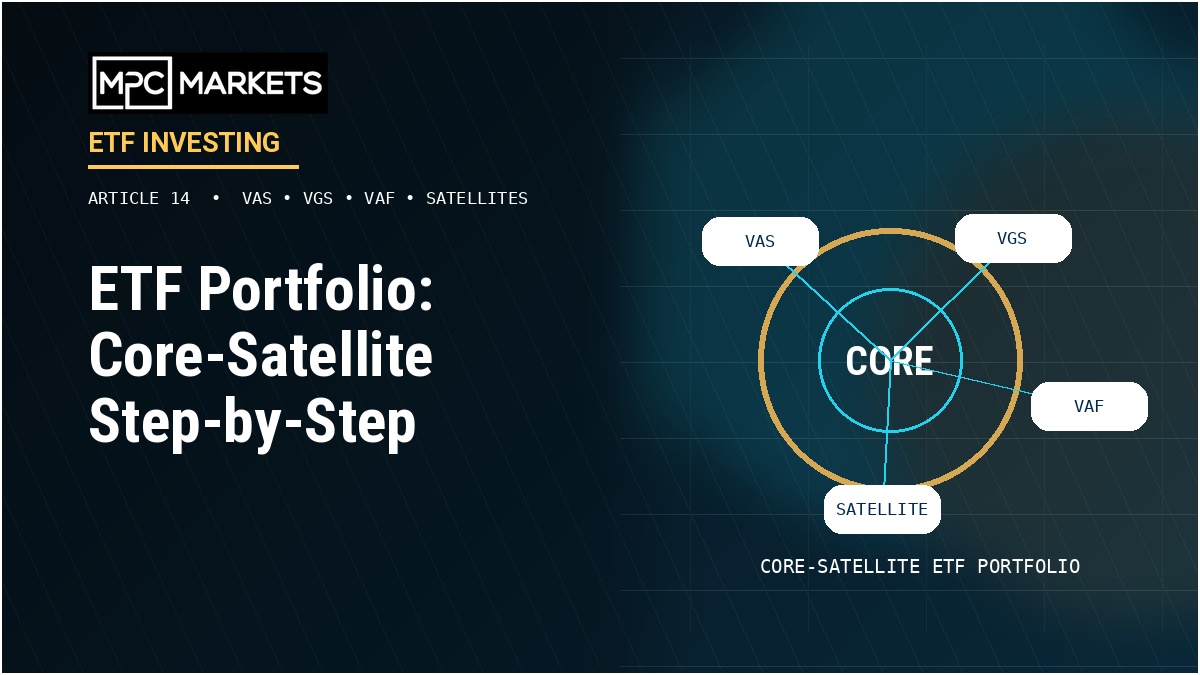
Think of your portfolio as concentric circles. The core (70-80% of holdings) is your bedrock: broad diversification, minimal costs, minimal fuss. The satellite (20-30%) is where you can express views or capture opportunities through thematic exposure, active bets, or tactical shifts.
Core: Australian shares ETF
Your home market exposure. The ASX 200 or ASX 300 is the obvious choice. VAS (Vanguard Australian Shares ETF) is the go-to pick: low cost at 0.08% MER, highly liquid, and owns the big dividend-paying names plus mid-caps and small-caps. A200 (SPDR S&P ASX 200) works too if you prefer a slightly different index methodology.
For most portfolios, one Australian shares ETF is enough. Don't overcomplicate this layer.
Core: International developed shares ETF
The US, Europe, and Japan run on different economic cycles and currency exposures than Australia. VGS (Vanguard Global Shares ETF) holds around 2,000 shares across developed markets, costs 0.15% MER, and includes dividend reinvestment. If you want to strip out currency volatility, VGAD (the hedged version) costs 0.19% MER.
A core allocation here is typically 30-50% of your equity exposure, depending on how comfortable you are with home-country bias. And yes, most Australians have far too much home-country bias in their portfolios.
Core: Bond ETF
Bonds aren't boring. They're ballast. In market downturns, bond prices typically rise while shares fall. In a diversified portfolio, bonds cushion the ride and give you something to rebalance from when equities get cheap.
VBND (Vanguard Australian Bonds ETF) owns Australian government and corporate bonds at 0.13% MER. VAF gives you international fixed income if you want geographic diversification in your bonds. Allocation depends on your risk profile: conservative investors might hold 40-50% bonds, growth-oriented investors 20-30%.
Satellite: Property and REITs ETF
Australian REITs provide yield, some inflation hedging, and diversification away from pure equity and bond risk. VAS already includes REITs (about 10% of the index), but if you want dedicated exposure, a 5-10% satellite allocation makes sense for most portfolios. Don't go overweight here unless you have specific conviction.
Satellite: Alternatives or thematic (optional)
This is where you can add non-correlated returns: commodities, managed volatility, or thematic exposure like clean energy or technology. Keep this layer small, around 5-15% of your portfolio. It's for tilts, not core holdings.
And be honest with yourself here. Are you adding thematic exposure because you genuinely believe in it, or because it's been hot lately? Conviction and FOMO are very different things.
Is your ETF mix right for you?
Not sure if your ETF mix is right for your situation? Book a complimentary MPC Portfolio Review.
Book Your Free ReviewHow do you determine the right ETF allocation for your risk profile?
Here's a simple framework. If you're saving for a goal less than 5 years away, you should be 50% or more in bonds. If you've got 10 or more years, you can be 80% or more in shares. If you're somewhere in between, use these starting points:
| Risk Profile | Australian Shares | International Shares | Bonds | Alternatives |
|---|---|---|---|---|
| Conservative | 40% | 20% | 40% | 0% |
| Balanced | 35% | 35% | 30% | 0% |
| Growth | 30% | 45% | 20% | 5% |
| Aggressive | 25% | 55% | 15% | 5% |
These are starting points, not gospel. Your actual allocation should reflect your income stability, existing assets, time horizon, and emotional tolerance for seeing red numbers on the screen. Some of you will want to tweak this, and that's what the satellite sleeve is for.
The modern 60/40 portfolio
Our Wealth Engine approach builds portfolios using the same core-satellite principles. See how the modern 60/40 works.
Explore Wealth EngineHow often should you rebalance an ETF portfolio?
Once you've built the portfolio, you need to maintain it. Rebalancing means selling winners and buying laggards to restore your target allocation. It sounds backwards, but it forces you to sell when things are expensive and buy when they're cheap. That's exactly how you extract returns over time.
How often? Quarterly or annually is fine for most investors. If you're adding new money monthly, you can rebalance by directing fresh contributions to whichever asset class has drifted below its target. That's actually the most tax-efficient way to do it, since you avoid triggering CGT on existing holdings.
And don't obsess over precision. If bonds should be 30% and they're sitting at 31%, that's noise. Rebalance when allocations drift by 5 percentage points or more from your target.
How much do MER costs actually matter over time?
A 0.20% difference in MER doesn't sound like much. Until you run the numbers over 20 years.
On a $500,000 portfolio, that 0.20% gap equals $1,000 per year in foregone compounding. And that $1,000 becomes around $8,000 after 20 years at 6% real returns. So yes, choose low-cost ETFs. But don't let a 0.05% difference paralyse you into doing nothing. The biggest cost in investing is usually procrastination, not fees.
Also factor in brokerage. Most Australian online brokers charge $10-20 per trade. If you're buying 5 ETFs and rebalancing quarterly, that's $200-400 per year in brokerage. Offset this by using brokers that offer contribution plans (fee-free regular investing) or by batching trades into quarterly windows.
Which platforms can you use for ETF investing in Australia?
Any ASX-licensed broker will let you buy ETFs. Popular options include:
| Platform | Best For | CHESS Sponsored? |
|---|---|---|
| Selfwealth, Stake, CommSec | Low flat fees, repeat investors | Yes |
| Interactive Brokers | International ETF access, lower FX costs | Yes |
| Sharesies, Raiz | Beginners, micro-investing | No (custodial) |
For most Australians, we'd recommend starting with Selfwealth or CommSec. They're reliable, transparent, and give you CHESS sponsorship, which means direct ownership on the share register. That matters for corporate actions and peace of mind.
What's the real key to ETF portfolio success?
The best portfolio is the one you actually build and maintain. Don't wait for the perfect entry point or spend six months agonising over the ideal allocation split. Choose a sensible starting allocation, begin investing, and let compounding do its thing.
You can refine as you go. The perfect is absolutely the enemy of the good when it comes to getting started with ETF investing. And the cost of waiting is almost always higher than the cost of getting your allocation slightly wrong.
Frequently Asked Questions
How many ETFs do I need for a diversified portfolio in Australia?
You can build a genuinely diversified portfolio with as few as three ETFs: an Australian shares ETF like VAS for ASX 300 exposure, an international shares ETF like VGS for global developed markets, and a bond ETF like VAF for Australian fixed income. Adding a fourth covering emerging markets or REITs adds further diversification. Beyond five or six ETFs, the extra diversification benefit drops off and complexity increases. Three well-chosen ETFs will outperform a complicated portfolio of 15 funds most of the time.
What is the core-satellite approach to ETF investing?
Core-satellite is a portfolio construction method where the core, typically 70 to 80 percent of the portfolio, is held in low-cost broadly diversified index ETFs providing stable market returns. The satellite, around 20 to 30 percent, holds more targeted positions like thematic ETFs, sector bets, active ETFs, or individual stocks designed to generate extra returns. The core protects capital and ensures you participate in market growth. The satellite provides upside opportunity. This approach balances cost efficiency with the ability to express investment views.
How often should I rebalance my ETF portfolio?
Most investors should rebalance once or twice annually, or when a position drifts more than 5 to 10 percentage points from its target allocation. Annual rebalancing captures mean-reversion benefits without excessive transaction costs. More frequent rebalancing creates more brokerage costs than benefits for most retail investors. Reinvesting new contributions into underweight positions is an efficient way to rebalance without triggering CGT on existing holdings.
What are the typical costs of an ETF portfolio in Australia?
Management expense ratios for passive index ETFs range from 0.03 percent for broad US market funds to around 0.20 percent for domestic or international ETFs. A well-constructed core portfolio of three to four passive ETFs should have a blended MER below 0.15 percent annually, meaning total fund management costs of around $150 per year on a $100,000 portfolio. Brokerage fees depend on your broker, typically $0 to $15 per trade. These are significantly lower than managed funds which often charge 0.5 to 1.5 percent annually.
Should I hedge my international ETF exposure to Australian dollars?
It depends on your time horizon and view on the Australian dollar. For long-term investors with 10 plus years, unhedged international exposure like VGS provides natural currency diversification, which tends to benefit Australians because the AUD often falls when global markets fall, cushioning your losses. For shorter time horizons or if you want to remove currency volatility, hedged options like VGAD lock in AUD returns from international shares. Many investors split the difference and hold a mix of hedged and unhedged.
ETF portfolio construction, explained live
We cover ETF portfolio construction regularly in our free webinars. Join the next one.
Register for Free WebinarThis article is general educational information and does not constitute financial advice. ETF investing carries risk, including the loss of capital. Past performance is not a guarantee of future results. Before investing, consider your personal circumstances, investment objectives, and risk tolerance. Consult a licensed financial adviser if you need personalised advice. MPC Markets holds an Australian Financial Services Licence (AFSL). All ETF references (VAS, VGS, VBND, VAF, VGAD, A200) are examples and do not constitute recommendations.
General Advice Warning: This information is general in nature and does not take into account your objectives, financial situation or needs. It is not personal financial advice. You should consider whether it is appropriate for your circumstances and seek professional advice before making any investment decision. Past performance is not a reliable indicator of future performance.