
Physical Gold vs Gold ETFs vs Mining Stocks: Which Is Best for Australians?
Last reviewed: May 2026
We reckon this is the most common question we get from clients right now. Gold prices in AUD are up significantly, geopolitical risk is elevated, and everyone wants to know: how do I actually get exposure? The short answer is that physical bullion, gold ETFs, and mining stocks are three genuinely different instruments. They share the word "gold" but they behave differently, carry different risks, and suit different people.
Let's get specific.
Should I buy physical gold for my portfolio?
Physical gold is the simplest and oldest form of gold ownership. You buy it, you own it, it sits in a vault or your safe. No company can go bust underneath you. No derivative expires. There's 3,000 years of monetary history in a coin or a bar, and that counts for something.
What physical gold gives you:
- Pure gold price exposure with no equity risk or operational noise layered on top
- Zero counterparty risk when stored in allocated form (your specific metal, identified in your name)
- Portfolio insurance that genuinely doesn't correlate with equities during real crises
- AUD gold exposure, which is a bigger deal than most people realise (more on that below)
What it doesn't give you:
- Income. Gold pays no dividend, no coupon, no yield. It just sits there looking shiny.
- Leverage to the gold price. Physical gives you 1:1 exposure, nothing more.
- Quick liquidity for large positions. Selling a big chunk of physical bullion takes time and involves wider bid-ask spreads.
Costs: You'll pay a purchase premium of 1 to 5% over spot, annual storage of 0.15 to 0.5% at professional vaults, insurance, and a buy-back spread when you exit.
Best for: Investors who want genuine portfolio insurance. Long-term wealth preservation. SMSF strategies with a 10+ year horizon. And anyone genuinely worried about systemic financial risks who wants assets outside the banking system.
Are gold ETFs a better option than physical gold?
For a lot of investors, honestly, yes. Gold ETFs give you gold price exposure without the storage headaches. On the ASX, the main options are PMGOLD (Perth Mint Gold, AUD-denominated, backed by physical gold at the Perth Mint) and GOLD (Perth Mint Physical Gold, which gives you USD gold price exposure).
What ETFs deliver:
- Liquid gold price exposure you can buy and sell on-market in seconds
- No storage or insurance hassle whatsoever
- Lower minimum investment than physical (you can buy a single unit)
- Fractional flexibility, sell exactly the amount you need when you need it
What they don't deliver:
- True ownership. You own units in a trust that holds gold, not the gold itself. There is counterparty risk, even if it's low with a provider like Perth Mint.
- The psychological certainty of physical possession. This matters more to some investors than others, and we're not going to pretend it doesn't.
- Income. Same as physical, nothing.
Costs: PMGOLD charges a management expense ratio of 0.15% per year. That's dirt cheap. No storage, no insurance worries.
Best for: Investors who want clean gold price exposure without complexity. SMSFs that need an auditable, straightforward gold position. Anyone building a diversified portfolio who needs efficient gold allocation without fussing about vault receipts.
Capital Protection Beyond Gold
Want capital protection beyond just gold? Our Wealth Protector strategy combines defensive assets for investors who can't afford to go backwards.
Learn About Wealth ProtectorWhat about gold mining stocks on the ASX?
Mining stocks are a fundamentally different animal. You're not buying gold. You're buying a business that digs gold out of the ground. And that distinction matters enormously.
The upside:
- Leverage to the gold price. A miner with $1,200/oz all-in sustaining costs (AISC) and gold at $3,000/oz has $1,800/oz in margin. If gold rises 20% to $3,600/oz, that margin jumps to $2,400, a 33% increase. That's where the leverage comes from.
- Income. Some miners pay dividends when gold prices are elevated and cash flow is strong.
- Growth optionality through new resource discoveries, mine expansions, and production increases.
The ugly part:
- Operational risk is real. Mining is hard. Equipment breaks. Grades disappoint. Permits get delayed. Management blows money on dud acquisitions.
- Equity market correlation during crises. When equity markets crash hard, even gold miners can fall initially as investors sell everything for liquidity. This partially defeats the point of holding gold as a crisis hedge.
- Cost inflation. AISC has risen materially over the past decade. Labour, energy, and materials costs chew into margins.
ASX examples: Newmont (NEM) has a dual ASX/NYSE listing. Northern Star Resources (NST), Evolution Mining (EVN), and Ramelius Resources (RMS) are the main quality mid-tier producers on the ASX.
Best for: Investors with higher risk tolerance who want leveraged gold exposure and are prepared to do proper fundamental analysis on individual companies. Not suitable as a "safe haven" or pure portfolio insurance position.
How do physical gold, ETFs, and mining stocks compare side by side?
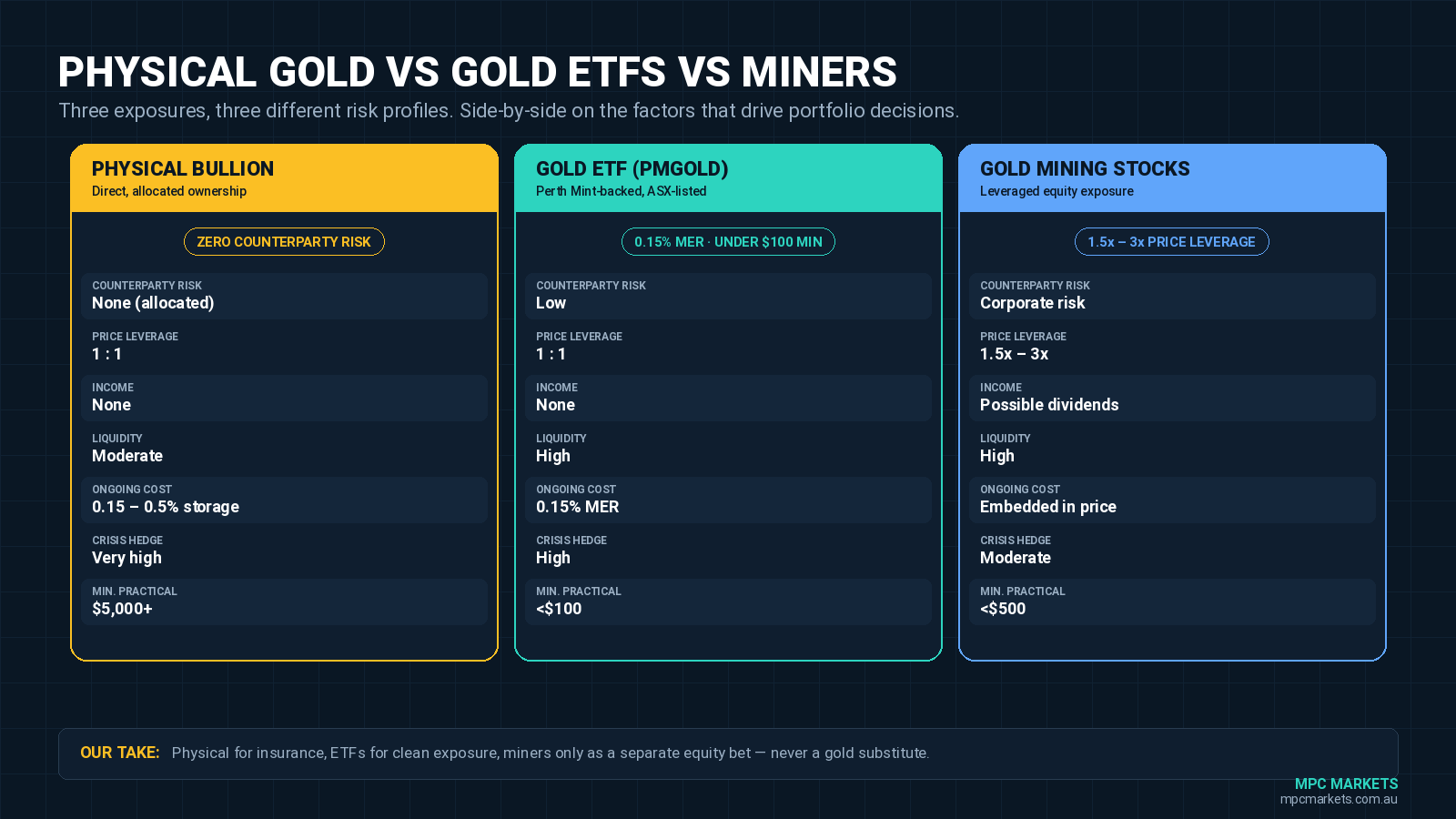
Here's where it gets clearer. The table below strips away the noise and shows you the key differences that actually matter for portfolio decisions.
| Factor | Physical Bullion | Gold ETF (PMGOLD) | Mining Stocks |
|---|---|---|---|
| Counterparty risk | None (if allocated) | Low | Corporate risk |
| Income | None | None | Possible dividends |
| Price leverage | 1:1 | 1:1 | 1.5x to 3x (varies) |
| Liquidity | Moderate | High | High |
| Ongoing cost | 0.15 to 0.5% storage | 0.15% MER | Operational costs embedded in price |
| Crisis hedge effectiveness | Very high | High | Moderate (equity correlation in crises) |
| Minimum practical investment | $5,000+ | Under $100 | Under $500 |
| SMSF admin complexity | Higher (ATO storage rules) | Low | Low |
Not Sure How to Split Your Gold Exposure?
Not sure how to split your gold exposure? Book a complimentary MPC Portfolio Review and we'll map it out.
Book Your Portfolio ReviewWhich gold investment suits which type of investor?
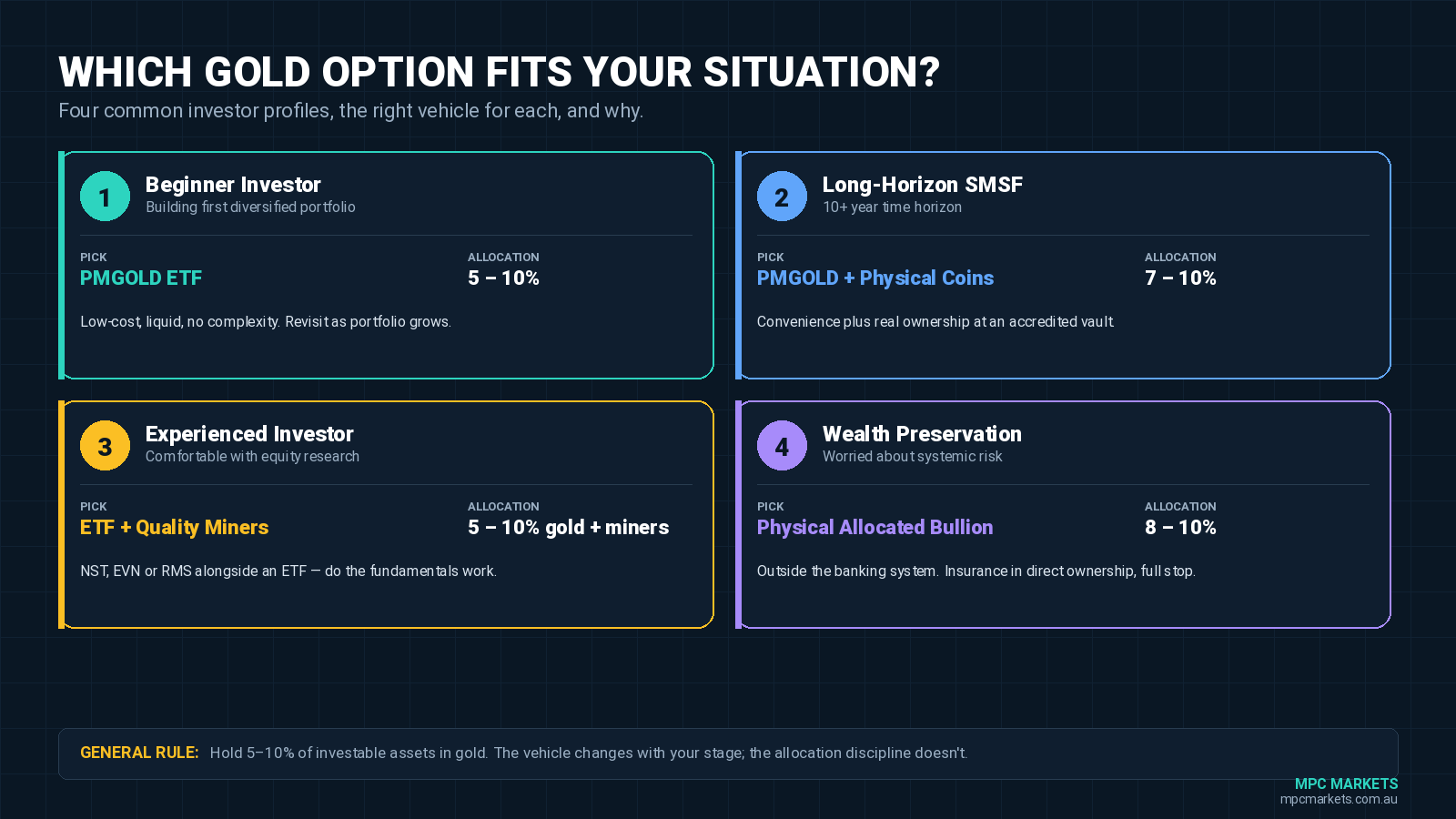
The beginner investor building their first diversified portfolio: start with PMGOLD. It's low-cost, liquid, and gives you gold price exposure without any complexity. Allocate 5 to 10% and revisit as your portfolio grows.
The SMSF investor with a long time horizon: we reckon a blend of PMGOLD (for liquidity and audit clarity) and physical coins stored at an accredited vault works well. You get both convenience and genuine ownership.
The experienced investor comfortable with equity research: a small allocation to quality ASX miners like Northern Star or Evolution Mining alongside a gold ETF gives you 1:1 gold exposure plus the possibility of leveraged upside. But you need to do the work on each individual company. No shortcuts here.
The wealth-preservation investor worried about systemic risk or currency debasement: physical bullion in allocated vault storage is the right vehicle. The insurance value is in direct ownership outside the financial system, full stop.
Why does gold work especially well for Australian investors?
Here's something that gets overlooked constantly, and it's a genuine edge for us. Gold is priced in USD globally. But the AUD tends to fall during global risk events because investors flee to USD. So when the world is in crisis and gold rises in USD terms, the AUD gold price rises even more.
Australian investors get a double benefit. It's not a small effect either. During the GFC, the AUD dropped from above 90 US cents to below 65 cents while gold was rising. That currency move amplified AUD gold returns significantly.
This AUD correlation makes gold an exceptionally effective hedge for Australian investors compared to US or European investors who already hold the reserve currency.
How is gold taxed differently depending on the investment type?
The three gold exposure types get different tax treatments, and it's worth understanding before you commit.
Physical bullion is treated as a capital asset. CGT applies when you sell. You get the 50% CGT discount after 12 months. No income is generated, so nothing is assessable until you actually dispose of it.
Gold ETFs like PMGOLD and GOLD get the same treatment as other ASX-listed investments. Capital gains on disposal with the 50% discount after 12 months. Some ETFs make distributions, though PMGOLD distributions are rare since the fund doesn't generate income in the traditional sense.
Gold mining stocks follow standard equity treatment. Dividends are assessable income and may carry franking credits. Capital gains on disposal with the 50% discount after 12 months. Some larger miners like Newmont pay meaningful dividends, which adds an income component that physical gold simply cannot provide.
For SMSF investors: all three can be held within an SMSF, but physical gold storage requires compliance with ATO guidelines on storage and control. Gold ETFs and mining stocks are the simplest SMSF options from an admin perspective.
Always talk to a registered tax adviser before making large commodity investments. We can point you in the right direction if you need one.
Frequently Asked Questions
Should I buy physical gold or a gold ETF like PMGOLD?
It depends on your priorities. If you want zero counterparty risk and direct ownership for wealth preservation, physical allocated bullion is the stronger choice. If convenience, low cost, and on-market liquidity matter more, PMGOLD or a similar ETF works well. Under $10,000 to invest, an ETF is usually more practical. Above $20,000, blending physical gold (via Perth Mint Depository) with an ETF for liquidity often makes the most sense.
What is the difference between PMGOLD and GOLD on the ASX?
Both are Perth Mint-backed ASX-listed gold products. PMGOLD is denominated in AUD and tracks the AUD gold price directly. GOLD is denominated in USD, so your return reflects both the USD gold price and AUD/USD currency movements. For most Australian investors, PMGOLD is simpler because it removes currency complexity from the equation.
Are ASX gold mining stocks a good substitute for physical gold?
No. Mining stocks give you leveraged exposure to gold prices, but they also bring operational risk, management risk, cost inflation, and equity market correlation during crises. A gold miner can fall sharply even when gold prices rise if costs blow out or a mine hits problems. For portfolio insurance, physical gold and gold ETFs are far more reliable. Think of mining stocks as equity investments with gold price exposure, not as gold substitutes.
How much gold should I hold in my investment portfolio?
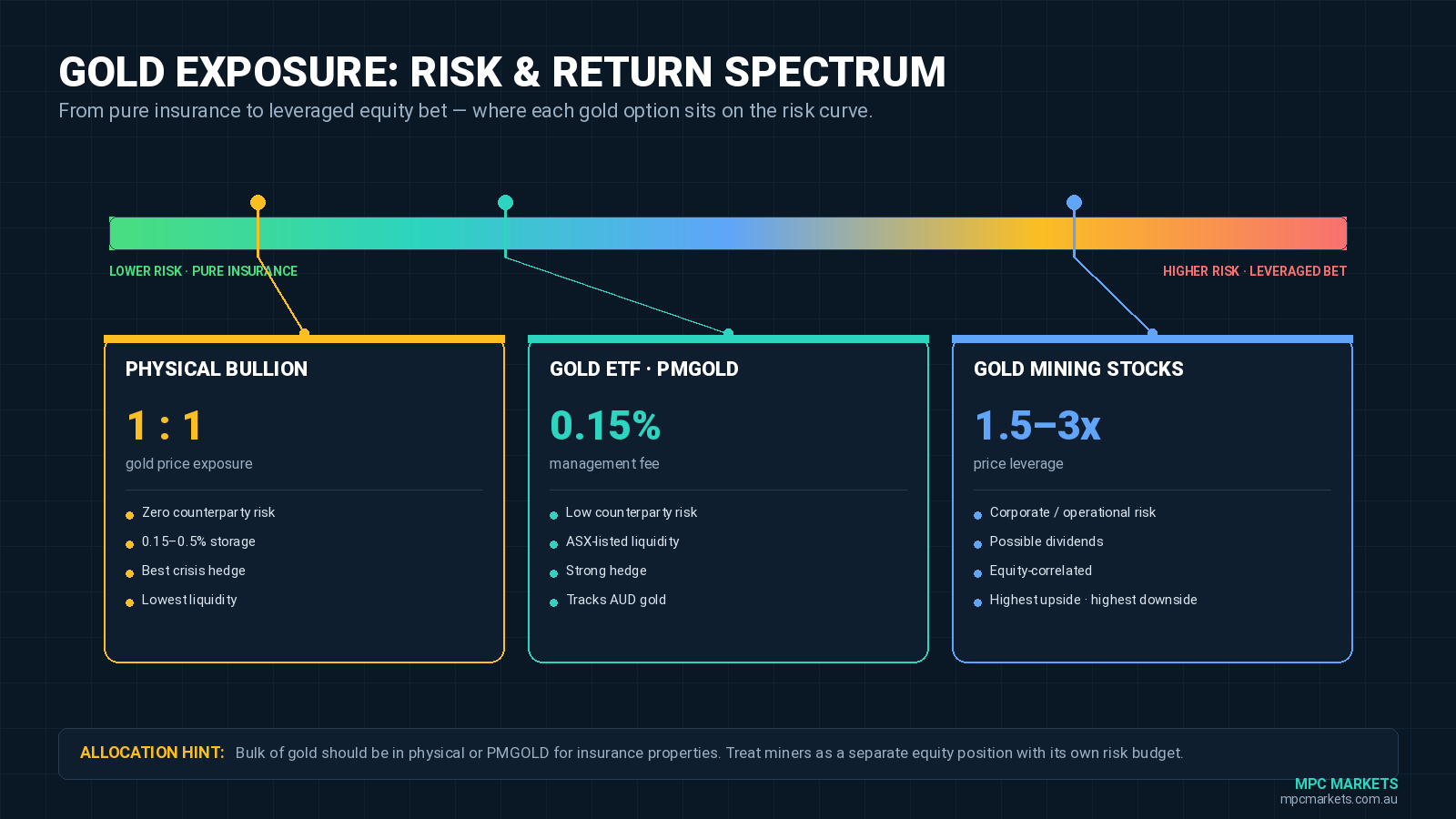
We generally suggest 5 to 10 percent of investable assets in gold-related investments for most Australian investors. That provides meaningful portfolio insurance without giving up too much return potential from equities and fixed income. Within that allocation, the bulk should be in physical bullion or gold ETFs for their insurance properties. Any mining stock exposure is better treated as a separate equity position with its own risk budget.
Is gold a good investment for Australian SMSFs?
Gold can work well inside an SMSF. Gold ETFs like PMGOLD are the simplest option from an administration and audit perspective. Physical bullion is also allowed but requires compliance with ATO storage and control rules. For most SMSF investors, a blend of PMGOLD for convenience and physical coins stored at an accredited vault provides both audit clarity and genuine ownership.
Free Precious Metals Webinars
We cover precious metals, portfolio insurance, and alternative assets in our free webinars.
Register for a WebinarThis article is for general educational purposes only and does not constitute personal financial advice. Investing in gold, gold ETFs, and mining stocks involves risk including the potential loss of capital. Past performance does not guarantee future results. ETF and stock examples are illustrative only and not recommendations. Before making investment decisions, consult a licensed financial adviser. MPC Markets holds an Australian Financial Services Licence (AFSL); see our About Us page for full regulatory details.