What Is Dollar Cost Averaging (DCA)? A Practical Guide for Australian Investors
Last reviewed: May 2026
Here's one of the most common questions we get from new clients: "I've got money to invest, but the market feels expensive. Should I wait for a dip?" And our answer is almost always the same. Stop trying to time it. Just start.
Dollar cost averaging is the strategy behind that advice. It's not glamorous. It won't make you feel like a genius trader. But it works, and it's how the vast majority of successful long-term investors actually build wealth in practice. Your super fund has been doing it for you your entire working life. You just might not have realised it.
We reckon DCA deserves a proper explanation because it's one of those concepts that sounds simple but has some genuine nuance underneath. And because there are real trade-offs involved that most "just DCA bro" advice on the internet completely ignores.
How does dollar cost averaging actually work?
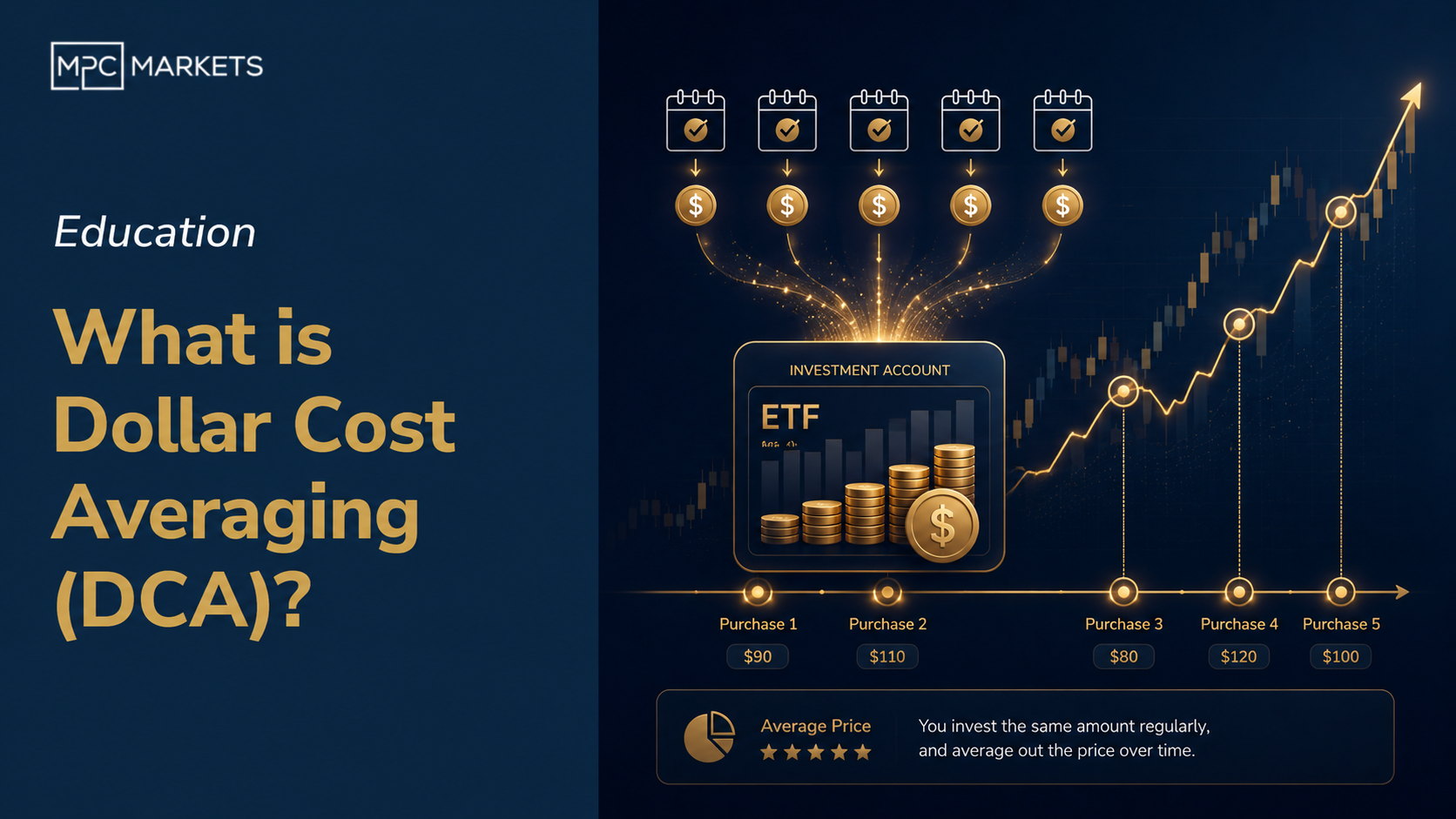
The mechanics are dead simple. You pick an amount. You pick a frequency. You invest that amount on that schedule, regardless of what the market is doing. That's it.
Say you decide to put $1,000 per month into a broad ASX ETF like VAS or A200. Some months the unit price will be high and you'll buy fewer units. Other months it'll be lower and you'll pick up more. Over time, your average purchase price ends up lower than the average market price across those same periods.
This happens because of basic maths. When you invest a fixed dollar amount, low prices automatically give you more units per dollar. You're naturally buying heavier when things are cheap and lighter when they're expensive. It's counter-intuitive because it feels like you should be doing the opposite, but the numbers don't lie.
And here's the thing most people miss: if you're employed in Australia, you're already doing DCA through your superannuation. Every pay cycle, a fixed percentage goes into your super fund and buys units at whatever the price happens to be that day. You've been dollar cost averaging your entire career. You just didn't call it that.
What does DCA look like with real numbers?
Let's walk through a concrete example. Imagine you've got $6,000 to invest in an ASX ETF over six months. You could put it all in at once, or you could spread it out at $1,000 per month. Here's what happens if the ETF price moves around:
| Month | ETF Price | Amount Invested | Units Bought |
|---|---|---|---|
| Month 1 | $100.00 | $1,000 | 10.00 |
| Month 2 | $85.00 | $1,000 | 11.76 |
| Month 3 | $70.00 | $1,000 | 14.29 |
| Month 4 | $65.00 | $1,000 | 15.38 |
| Month 5 | $80.00 | $1,000 | 12.50 |
| Month 6 | $90.00 | $1,000 | 11.11 |
| Total | Avg price: $81.67 | $6,000 | 75.04 |
Your average cost per unit works out to about $79.96 ($6,000 divided by 75.04 units). That's lower than the simple average price of $81.67 across those six months. And significantly lower than the $100 you would have paid if you'd put the entire $6,000 in on day one.
Now, this example deliberately shows a market that dips and partially recovers. DCA doesn't always produce a better result than lump sum, and we'll get to that honestly in a moment. But in a volatile market, the maths consistently works in favour of the regular investor.
Not sure where to start your DCA plan?
Book a free Portfolio Review and we'll help you build a disciplined investment plan that fits your budget and goals.
Book Your Free ReviewDoes lump sum investing actually beat DCA?
Yes. And we think it's worth being upfront about this because too many finance articles treat DCA like it's always the optimal strategy. It's not.
Research from Vanguard and Schwab has consistently shown that investing a lump sum immediately outperforms DCA roughly 65 to 70% of the time over 12-month periods. The reason is straightforward: share markets go up more often than they go down. If you're sitting on cash and drip-feeding it in over months, you're keeping money out of a market that's probably rising. That uninvested cash is earning less than it would have in the market.
So if the data favours lump sum investing, why does anyone bother with DCA? Three reasons.
First, most people don't have a lump sum. If you're investing from your salary each month, there's no lump sum versus DCA decision to make. You're investing as the money arrives. That's DCA by default.
Second, the 30 to 35% of the time when DCA wins tends to be during the periods that hurt the most. Investing a lump sum right before a major drawdown is financially and psychologically devastating. DCA protects you from that worst-case scenario. It's a form of risk management, not return optimisation.
Third, behaviour beats theory. The best investment strategy is the one you actually stick with. If the thought of putting $50,000 into the market all at once makes you so nervous that you end up not investing at all, then DCA is the superior strategy for you. Full stop. Money sitting in a savings account earning 4% because you're waiting for the "right time" is almost always worse than money in the market on a regular schedule.
Building wealth on a regular schedule?
Our Wealth Builder strategy is designed for investors who want to grow their portfolio systematically over time.
Explore Wealth BuilderWhat are the real benefits of dollar cost averaging?
We've covered the headline stuff, but there are some underappreciated advantages worth spelling out.
Does DCA remove the need to time the market?
Completely. And that's a bigger deal than it sounds. Market timing is extraordinarily difficult. Even professional fund managers get it wrong more often than right. By committing to a regular schedule, you sidestep the entire problem. You don't need an opinion on whether the ASX is overvalued or whether a correction is coming. You just invest.
How does DCA help during volatile markets?
Volatility is actually your friend when you're dollar cost averaging. Think about it: wild price swings mean you're occasionally buying at bargain prices that wouldn't exist in a calm market. A sharp dip that terrifies lump sum investors is a discount for the DCA investor. You're buying more units at that lower price, and when the market recovers those extra units amplify your returns.
Does DCA make investing psychologically easier?
Massively. We've seen this with clients over and over. The anxiety of investing a large sum disappears when you break it into smaller regular amounts. There's something about committing $1,000 a month that feels manageable in a way that committing $50,000 doesn't, even though the eventual total might be similar. And because each individual investment is smaller, a bad month doesn't feel catastrophic.
Is DCA good for building discipline?
This might be the most underrated benefit. Regular investing creates a habit. It becomes automatic, like paying rent or a mortgage. Once you've set up an automatic transfer to your broker, investing stops being a decision you make each month and becomes something that just happens. That consistency is what actually builds wealth over decades. Not stock picking. Not timing. Consistency.
What are the genuine drawbacks of DCA?
We've been pretty positive so far, so let's balance the ledger. DCA has real limitations and we think you should understand them.
Opportunity cost is real. As we mentioned, lump sum investing wins most of the time historically. If you have $100,000 sitting in cash and you DCA it over 12 months, you'll probably end up with less money than if you'd invested it all on day one. Probably. Not certainly, but probably.
DCA doesn't protect you against prolonged declines. If the market falls steadily for two years, DCA means you're buying all the way down. Yes, you're buying cheaper than someone who lump-summed at the top, but you're still losing money on every purchase. DCA reduces timing risk. It doesn't eliminate market risk.
Watch your brokerage costs. This matters more than people realise, especially for smaller regular investments. If you're investing $200 per month and paying $10 brokerage each time, that's 5% of your investment gone before you start. We reckon you should keep brokerage under 1% of each purchase. Some platforms now offer zero or low-cost brokerage for ETF purchases, which makes smaller DCA amounts more viable.
Slower capital deployment. In a strongly rising market, drip-feeding money in means your earlier purchases do well but your later cash misses out on those early gains. Time in the market matters, and DCA by definition delays full market exposure.
Who is DCA best suited for?
We reckon DCA works particularly well for a few specific groups of investors.
New investors just getting started. If you've never invested before, DCA takes the pressure off completely. You don't need to learn technical analysis or have a view on where the market's heading. You just need to set up a recurring transfer and pick a diversified ETF portfolio.
Regular income earners. If you're on a salary and want to build an investment portfolio alongside your super, monthly DCA is the natural approach. Treat it like another bill. Money comes in, a portion goes straight to your broker.
Nervous lump sum holders. Sitting on an inheritance, a bonus, or proceeds from a property sale? If the thought of investing it all at once makes you anxious, spread it over three to six months via DCA. Yes, lump sum is statistically better. But actually investing is infinitely better than paralysis.
Long-term retirement savers. Whether it's additional super contributions or a separate investment account, DCA and long time horizons are a powerful combination. The longer you invest regularly, the more market cycles you capture, and the more the volatility-smoothing effect compounds in your favour.
Anyone who's been burned by market timing. If you've ever sold at the bottom or bought at the top because you thought you knew where the market was heading, DCA is your antidote. It removes you from the equation. And honestly, for most investors, removing yourself from the decision-making process is the single most valuable thing you can do.
How do you actually set up a DCA plan in Australia?
The practical steps are straightforward.
Step 1: Decide on your amount and frequency. Monthly is the most common, but fortnightly works too, especially if that aligns with your pay cycle. The amount should be something you can sustain for years, not months. Better to start with $500 per month consistently than $2,000 per month that you abandon after three months when something unexpected comes up.
Step 2: Choose your investment. For most DCA investors, a broad market ETF is the sweet spot. Something like VAS for Australian shares, VGS for international, or a combination. The key is diversification. You don't want to DCA into a single stock because if that company goes sideways for years, the averaging effect doesn't help. A broad ETF gives you the market return, which historically has been positive over long periods.
Step 3: Automate where possible. Some Australian brokers allow automatic recurring investments. Use that feature if it's available. The less you have to manually execute each month, the more likely you are to stick with it. Remove the human from the loop.
Step 4: Ignore the noise. This is the hard part. When markets drop 10%, your instinct will be to pause your DCA plan and wait. Don't. That's the exact moment DCA is working hardest for you, buying more units at lower prices. When markets surge, you'll feel like putting extra in. Resist that too. The whole point is consistency.
What's our honest take on DCA at MPC Markets?
We're fans. Not because DCA is theoretically optimal, because it isn't always. But because it's practical, sustainable, and it actually gets people investing instead of overthinking. In our experience, the biggest risk for most Australian investors isn't buying at the wrong time. It's not buying at all.
If you've got a lump sum and you genuinely won't panic in a downturn, investing it all at once is probably the better move. We won't pretend otherwise. But if there's any doubt, if you'd second-guess yourself at the first sign of red on the screen, then DCA over three to six months is the sensible compromise.
And for everyone investing from regular income? DCA isn't a strategy you're choosing. It's just what investing looks like when you're building wealth from scratch. Embrace it. Automate it. And give it time to work.
As Benjamin Graham put it, the disciplined investor's greatest advantage is buying more shares when the market offers them at a discount. DCA does exactly that, automatically.
Learn investing fundamentals in our free webinars
We cover DCA strategies, portfolio construction, and market timing myths in our regular webinar series.
Browse Upcoming WebinarsWhat is dollar cost averaging and how does it work?
Dollar cost averaging means investing a fixed dollar amount at regular intervals regardless of what the market is doing. You might invest $500 every month into an ASX ETF. When prices are low you automatically buy more units. When prices are high you buy fewer. Over time this smooths out your average purchase price and removes the pressure of trying to time the market perfectly.
Is DCA better than investing a lump sum?
Historically, lump sum investing outperforms DCA roughly 65 to 70 percent of the time because markets trend upwards over time and getting your money in earlier gives it more time to compound. However, DCA significantly reduces the risk of investing a large amount at a market peak. For most people who are investing from regular income rather than sitting on a lump sum, DCA is the natural and practical approach anyway.
How much should I invest each month with DCA in Australia?
There is no magic number. The right amount is whatever you can consistently invest without putting strain on your living expenses. Some people start with $200 per month, others with $1,000 or more. The consistency matters more than the amount. Factor in brokerage costs though. If your broker charges $10 per trade, investing $100 monthly means 10 percent of your money goes to fees. Keep brokerage below 1 percent of each investment where possible.
Can I use dollar cost averaging with super contributions in Australia?
You already are. If you are employed in Australia, your employer's compulsory super contributions are a form of dollar cost averaging. A fixed percentage of your salary goes into your super fund at regular intervals and buys units at whatever the current price happens to be. You can amplify this effect by making additional voluntary contributions on a regular schedule, which also provides potential tax benefits through salary sacrifice or personal deductible contributions.
What are the best investments for a DCA strategy on the ASX?
Broad market ETFs are ideal for DCA because they give you instant diversification with a single purchase. Popular choices on the ASX include VAS for Australian shares, VGS for global shares, and A200 for low-cost ASX 200 exposure. The key is choosing something you are comfortable holding for the long term so you stick with the plan through market ups and downs. Avoid trying to DCA into speculative individual stocks where the long-term direction is uncertain.
Disclaimer: This article is for educational purposes only and does not constitute personal financial advice. All investing involves risk, including the potential loss of capital. Past performance is not indicative of future results. The example scenarios used are hypothetical and for illustration only. Dollar cost averaging does not guarantee a profit or protect against loss in declining markets. Consider your own financial situation, objectives, and risk tolerance before making investment decisions. MPC Markets recommends consulting a licensed financial adviser for advice tailored to your circumstances. MPC Markets Pty Ltd holds AFSL 538374.


Mark Gardner
Software Engineer
Mark Gardner is CEO and Head of Equities at MPC Markets, with 30 years of experience spanning broking, trading, trader mentoring and investment advice. He's a regular expert on ausbiz "the call," "the open," "the COB" and "the investment committee," specialising in Australian listed equities, global stocks and technical analysis